Diagnosis
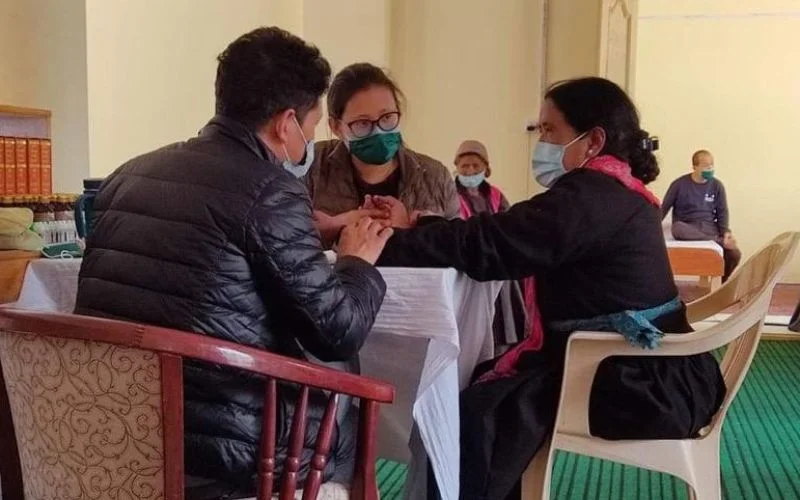
Tibetan Diagnosis
In traditional Tibetan medicine (Sowa Rigpa), diagnosis is the art of discerning subtle energetic imbalances among the three physical humors (nyapas): Lung (Wind), Tripa (Bile), and Beken (Phlegm). Rather than merely identifying symptoms, Tibetan diagnostic methodology aims to unveil the root cause of systemic disharmony through sensory evaluation, intuitive observation, and rigorous physical examination. The classical framework divides diagnosis into three primary modes known as the Three Pillars of Diagnosis: Visual Observation (Lta-ba), Palpation (Reg- pa), and Interrogation (Dri-ba).
Initial DiagnosisVisual Observation (Lta-ba)
Visual inspection involves assessing the patients physical appearance, posture, complexion, eye color, and tongue characteristics. However, the cornerstone of visual diagnosis in Sowa Rigpa is Urinalysis (Chhu-tag).
1. Preparation: The patient follows specific dietary and behavioral rules the night before. Fresh early-morning urine is collected in a white
porcelain vessel.
2. Evaluation: The physician examines the sample across three
stages—when hot, warm, and cold. They analyze color, vapor, odor, bubbles, scum, and sediment.
3. Interpretation:
o A light, bluish tint with large, rapid bubbles signifies a Lung
(Wind) disorder.
o A reddish-yellow hue with strong vapor and thick sediment
indicates a Tripa (Bile/Heat) imbalance.
o A whitish, translucent color with minimal vapor points to a Beken(Phlegm/Cold) disorder.
Palpation (Reg-pa)
Palpation (Reg-pa)
Palpation centers on Pulse Diagnosis (Rtsa-tag), arguably the most
sophisticated and refined diagnostic tool in Tibetan medicine.
1. Methodology: Performed early in the morning before breakfast, the
physician places three fingers (index, middle, and ring) on the radial
artery of each wrist, about one finger-breadth below the wrist crease.
Each finger press is divided into upper and lower technique, allowing the practitioner to read twelve distinct organ pulses corresponding to the solid organs (Don-nga, e.g., heart, liver, kidneys) and hollow organs
(Snod-drug, e.g., stomach, gallbladder, bladder).
2. Pulse Qualities:
o Lung Pulse: Floating, empty, and irregular like a bubble in a
stream.
o Tripa Pulse: Rapid, strong, and taut like a stretched cord.
o Beken Pulse: Sunken, slow, and weak.
Palpation also includes assessing body temperature, skin texture, and tenderness at specific spinal reflex points.
Interrogation (Dri-ba)
Inquiry allows the physician to gather essential contextual data regarding the patients lifestyle and background. The practitioner asks detailed questions about:
1. Diet and Digestion: Preferred foods, eating habits, appetite, and bowel
movements.
2. Environment and Behavior: Daily routines, sleep patterns, physical
activity, and geographic environment.
3. Psychological State: Emotional triggers, stress levels, and recurring
mental patterns.
4. Symptom History: Onset, location, duration, and conditions that
aggravate or relieve discomfort.